spfautsch
Member
This is sort of a follow-up on a question thread I posted several weeks ago that turned into a bit of a flamer and has since been mercifully deleted. Apologies to @TollKeeper, but I think I have sufficiently answered the why now.
As I'm waiting on some parts and wont be able to finish this job until sometime next week I wanted to post my thoughts and observations while they're still fresh in my memory, as it's not been improving proportionally with age.
First off, to the point of the need for a cam swap. After pulling the heads off yesterday afternoon I spent most of the last 5-6 hours working with a dial indicator and degree wheel to see what's up with these AFM cams.
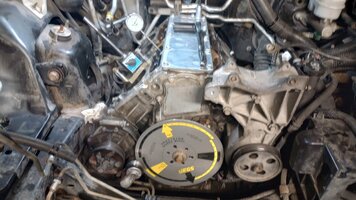
Here's what I found - on these dual-function cams the AFM lobes have both greater lift and duration than the non-AFM lobes. Valve opening events, when measured at 0.050" tappet lift happened 3-4 degrees sooner on AFM cylinders than on their full-duty counterparts while closing events seemed to be timed identically. Additionally, the AFM lobes measured an average of 0.286" lift at the tappet, while non-AFM lobes measured an average of 0.275" lift. While these aren't drastic differences, if one were to install standard lifters on all cylinders without changing the cam, the difference in area under the curve would certainly cause a large enough difference in cylinder filling to create random lean misfires on the cylinders getting the bigger intake air charge. Though it's widely been posted that the AFM cylinders exhibit lower compression after a lifter-only swap on one of these engines, by my estimation it seems the evidence indicates that the non-AFM cylinders would be the ones demonstrating lesser cylinder filling and thus lower static compression. But as I have no intention of expending a set of head bolts and gaskets to test this theory, feel free to speculate.
However you look at it, this satisfies my desire to understand the why behind the need for a non-AFM cam for this job. Although if you have one of the gen 5 engines that have AFM / DFM on all 8 cylinders, I think you'd be perfectly fine running the stock cam.
Next topic is parts. As I already had a large collection of LS7 lifters and other assorted pieces I chose to cherry pick the parts I knew I absolutely needed instead of buying a kit. I won't discourage you from any vendor selling such a kit, but will only mention my personal experience with the vendors I dealt with for individual part sets that were either an exceptionally good or bad value.
First off is lifter trays. As I already have a Prime subscription I found what I thought was a good deal on a set of 4 lifter trays on Amazon. Save yourself the trouble. When I installed one yesterday while using the degree wheel I found that the tray would rock from side to side as the adjacent cylinder's lifters moved. The old trays didn't exhibit this characteristic. Also just looking at the webbing inside the moldings as well as the fact that the material thickness was such that the retainer bolts didn't contact the plastic at all, these just seemed like a recipe for disaster.
Solution: Rock Auto has the GM trays for less than $12 each. This is one of the parts I'm waiting on so I'll have to post an update with a comparison later, but meanwhile I'm kicking myself for pinching pennies on this item.
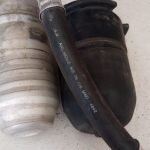
Second order of business is the valley cover plate to block off the VLOM oil passages. I made the mistake of finding one on eBay from a seller that had US based inventory but the parts were manufactured in China. The casting quality was terrible and I feared there would be leaks around the oil pressure sensor port so I asked to return it. It didn't go as well as I would've liked. The picture below is a comparison of their part next to another that was located on Amazon thanks to a suggestion by @Mooseman.

One of the "good deals" I ran into was a mostly complete Mahle branded gasket set from Rock Auto that contains two head gaskets, intake gaskets, exhaust manifold gaskets, the exhaust donut for the passenger side, valve stem seals (important thing to consider on a high-mileage buggy), a valley cover gasket, all 16 fuel injector o-rings, and a number of other gaskets you may or may not need.
The other "good deal" was a set of Fel-Pro branded head bolts for less than could be found elsewhere. Combined shipping costs may make this a better deal than if not buying a bunch of stuff from Rock Auto simultaneously.
Tips, in no particular order...
* Remove the temperature sensor from the driver side cylinder head before you attempt to remove the head bolt. It's a cheap and common part, but if there's nothing wrong with yours, you'll be money ahead removing it as I broke the bejeesus out of the connector shell on mine removing that head bold w/ a power-operated tool.
* Plan on purging your refrigerant system and buy a full set of seals to replace every one you touch as these vehicles are coming alarmingly close to being licensable as historic vehicles. Removing the condenser core, while possibly not absolutely necessary, creates a very useful "mechanic's cubby hole" that will make everything you work on afterwards a much smaller pain in the posterior. Trust me, your sternum will thank you for not trying to work in a "superman pose".
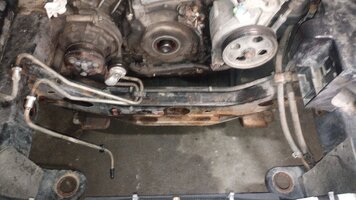
* Be careful removing the quick-disconnect heater hoses as I've heard they're easily broken and can only be purchased from GM.
* I'm sure this is old news to anyone owning one of these vehicles, but for the love of !doG be extra careful when removing nuts, bolts and spark plugs that might fall into the no-mans-land that encompasses the entire underhood area. Thus far in this project I'm only needing to recover a lost #5 spark plug and one of the fancy Dorman stainless steel exhaust stud nuts (that won't stick to a magnet). I'm very happy to report that none of my cherished wrenches, sockets, or extensions have been sacrificed to the aforementioned black hole!
Also, there is the topic of ECM reflashing to disable the switch to 4 cylinder mode and the subsequent DTCs related to disconnecting the VLOM solenoid control connector that typically accompany an AFM delete procedure. I have absolutely nothing bad to say about the assumed "forum preferred" vendor Jeremy @ http://lime-swap.com, but with some searching I found another mail-order guy that was closer to me and 75% less - Branden @ http://lt1swap.com. Branden not only shared experiences with me on older (AKA "antique") platforms such as the gen 2 LT-1, but also shared some first-hand experiences he had with another gremlin I've been chasing - the T42 transmission controller weirdness I've been struggling with and chronicled here.
I have much more to share on this subject and will gladly answer questions to the best of my ability. I've spent dozens if not hundreds of hours trying to find a truly definitive answer to the question of "do you need to replace the cam if performing an AFM delete?". I'm not claiming to be the authority on this subject, but I'm now comfortable in the reflection of the knowledge I've personally gathered that this is a legitimate statement.
Hope to share more as this project continues.
As I'm waiting on some parts and wont be able to finish this job until sometime next week I wanted to post my thoughts and observations while they're still fresh in my memory, as it's not been improving proportionally with age.
First off, to the point of the need for a cam swap. After pulling the heads off yesterday afternoon I spent most of the last 5-6 hours working with a dial indicator and degree wheel to see what's up with these AFM cams.
Here's what I found - on these dual-function cams the AFM lobes have both greater lift and duration than the non-AFM lobes. Valve opening events, when measured at 0.050" tappet lift happened 3-4 degrees sooner on AFM cylinders than on their full-duty counterparts while closing events seemed to be timed identically. Additionally, the AFM lobes measured an average of 0.286" lift at the tappet, while non-AFM lobes measured an average of 0.275" lift. While these aren't drastic differences, if one were to install standard lifters on all cylinders without changing the cam, the difference in area under the curve would certainly cause a large enough difference in cylinder filling to create random lean misfires on the cylinders getting the bigger intake air charge. Though it's widely been posted that the AFM cylinders exhibit lower compression after a lifter-only swap on one of these engines, by my estimation it seems the evidence indicates that the non-AFM cylinders would be the ones demonstrating lesser cylinder filling and thus lower static compression. But as I have no intention of expending a set of head bolts and gaskets to test this theory, feel free to speculate.
However you look at it, this satisfies my desire to understand the why behind the need for a non-AFM cam for this job. Although if you have one of the gen 5 engines that have AFM / DFM on all 8 cylinders, I think you'd be perfectly fine running the stock cam.
Next topic is parts. As I already had a large collection of LS7 lifters and other assorted pieces I chose to cherry pick the parts I knew I absolutely needed instead of buying a kit. I won't discourage you from any vendor selling such a kit, but will only mention my personal experience with the vendors I dealt with for individual part sets that were either an exceptionally good or bad value.
First off is lifter trays. As I already have a Prime subscription I found what I thought was a good deal on a set of 4 lifter trays on Amazon. Save yourself the trouble. When I installed one yesterday while using the degree wheel I found that the tray would rock from side to side as the adjacent cylinder's lifters moved. The old trays didn't exhibit this characteristic. Also just looking at the webbing inside the moldings as well as the fact that the material thickness was such that the retainer bolts didn't contact the plastic at all, these just seemed like a recipe for disaster.
Solution: Rock Auto has the GM trays for less than $12 each. This is one of the parts I'm waiting on so I'll have to post an update with a comparison later, but meanwhile I'm kicking myself for pinching pennies on this item.
Second order of business is the valley cover plate to block off the VLOM oil passages. I made the mistake of finding one on eBay from a seller that had US based inventory but the parts were manufactured in China. The casting quality was terrible and I feared there would be leaks around the oil pressure sensor port so I asked to return it. It didn't go as well as I would've liked. The picture below is a comparison of their part next to another that was located on Amazon thanks to a suggestion by @Mooseman.
One of the "good deals" I ran into was a mostly complete Mahle branded gasket set from Rock Auto that contains two head gaskets, intake gaskets, exhaust manifold gaskets, the exhaust donut for the passenger side, valve stem seals (important thing to consider on a high-mileage buggy), a valley cover gasket, all 16 fuel injector o-rings, and a number of other gaskets you may or may not need.
The other "good deal" was a set of Fel-Pro branded head bolts for less than could be found elsewhere. Combined shipping costs may make this a better deal than if not buying a bunch of stuff from Rock Auto simultaneously.
Tips, in no particular order...
* Remove the temperature sensor from the driver side cylinder head before you attempt to remove the head bolt. It's a cheap and common part, but if there's nothing wrong with yours, you'll be money ahead removing it as I broke the bejeesus out of the connector shell on mine removing that head bold w/ a power-operated tool.
* Plan on purging your refrigerant system and buy a full set of seals to replace every one you touch as these vehicles are coming alarmingly close to being licensable as historic vehicles. Removing the condenser core, while possibly not absolutely necessary, creates a very useful "mechanic's cubby hole" that will make everything you work on afterwards a much smaller pain in the posterior. Trust me, your sternum will thank you for not trying to work in a "superman pose".
* Be careful removing the quick-disconnect heater hoses as I've heard they're easily broken and can only be purchased from GM.
* I'm sure this is old news to anyone owning one of these vehicles, but for the love of !doG be extra careful when removing nuts, bolts and spark plugs that might fall into the no-mans-land that encompasses the entire underhood area. Thus far in this project I'm only needing to recover a lost #5 spark plug and one of the fancy Dorman stainless steel exhaust stud nuts (that won't stick to a magnet). I'm very happy to report that none of my cherished wrenches, sockets, or extensions have been sacrificed to the aforementioned black hole!
Also, there is the topic of ECM reflashing to disable the switch to 4 cylinder mode and the subsequent DTCs related to disconnecting the VLOM solenoid control connector that typically accompany an AFM delete procedure. I have absolutely nothing bad to say about the assumed "forum preferred" vendor Jeremy @ http://lime-swap.com, but with some searching I found another mail-order guy that was closer to me and 75% less - Branden @ http://lt1swap.com. Branden not only shared experiences with me on older (AKA "antique") platforms such as the gen 2 LT-1, but also shared some first-hand experiences he had with another gremlin I've been chasing - the T42 transmission controller weirdness I've been struggling with and chronicled here.
I have much more to share on this subject and will gladly answer questions to the best of my ability. I've spent dozens if not hundreds of hours trying to find a truly definitive answer to the question of "do you need to replace the cam if performing an AFM delete?". I'm not claiming to be the authority on this subject, but I'm now comfortable in the reflection of the knowledge I've personally gathered that this is a legitimate statement.
Hope to share more as this project continues.
Last edited: